Project details
- Commercial Scratched Glass Repair
- December 2005
- Pacific Palisades, CA
- 5
- Extreme
- 14 days
- 4,000
- Construction cleanup, window washer scrapers
- Malibu CA, Pacific Palisades CA
Service Areas — Malibu & Southern California:
- Malibu, CA
- Pacific Palisades, CA
- Santa Monica, CA
- Brentwood, CA
- Bel Air, CA
- Beverly Hills, CA
- West Hollywood, CA
- Los Angeles, CA
- Calabasas, CA
- Agoura Hills, CA
- Thousand Oaks, CA
- Westlake Village, CA
- Camarillo, CA
- Ventura, CA
- Oxnard, CA
- Santa Barbara, CA
- Montecito, CA
- Ojai, CA
- Pasadena, CA
- Glendale, CA
- Burbank, CA
- Sherman Oaks, CA
- Encino, CA
- Tarzana, CA
- Woodland Hills, CA
- Hidden Hills, CA
- Palos Verdes, CA
- Manhattan Beach, CA
- Hermosa Beach, CA
- Redondo Beach, CA
First Commercial Scratched Glass Repair Project - 2005


Table of Contents
Morley Builders Were Skeptics. Until They Weren’t.
It was December 2005. Rick Evans was living in San Luis Obispo, California — beautiful town, tight budget — installing retrofit windows under a contractor’s license that wasn’t his own. He had recently figured something out that nobody in the glass industry believed was possible: removing deep scratches from tempered glass using a dry grinding process he developed himself. No manual. No mentor. No roadmap. Just experimentation, persistence, and a process that worked.
The way he was getting work in those days? Faxes. Actual fax machines. Cold faxes sent to glass shops, builders, and property managers up and down the California coast. Most went nowhere. One landed on the right desk at Morley Builders — one of Southern California’s most respected commercial construction companies — and the phone rang.
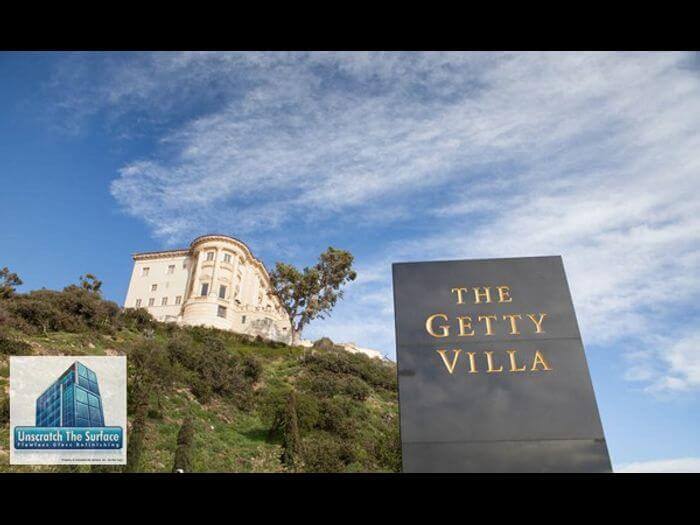
The job was at the Getty Villa in Malibu. Not a storefront. Not an office building. The Getty Villa — the former private residence of J. Paul Getty himself, one of the wealthiest men who ever lived, now a world-class museum of ancient Greek, Roman, and Etruscan antiquities set into the hills of Pacific Palisades, 500 feet above Pacific Coast Highway. Manicured gardens. Roman architecture. Priceless art. And deer — actual deer wandering the property like they owned the place, which in a way, they did.
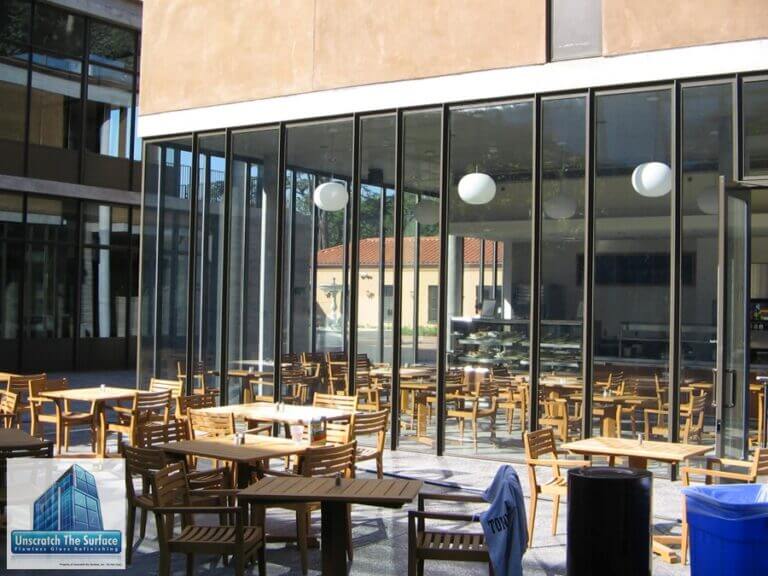
The problem: contractors doing a polished concrete floor installation — inside and out — had been careless with their cleanup. Concrete splashed onto large sections of laminated tempered glass. Workers wiped it down with wet towels, reusing the same dirty water until the abrasive slurry had ground scratches into both sides of the glass. Both sides. On laminated glass, that’s a particularly unforgiving situation — any minor distortion compounds when both surfaces are affected, meaning the margin for error was essentially zero.
The Morley Builders contractor showed up the first morning wearing the expression of a man who had serious doubts. Replacing the glass outright would cost over $100,000. This guy from San Luis Obispo with a fax machine was claiming he could fix it. In two weeks. For a fraction of the cost.
Sure you can, pal.
He watched for a while. Then the results started speaking for themselves. Within days the skepticism evaporated — he left Rick and Joey alone to work and never really hovered again. That’s the highest compliment a contractor can pay. It means the work earned the trust before the job was done.
Two Weeks Blinded by the Light
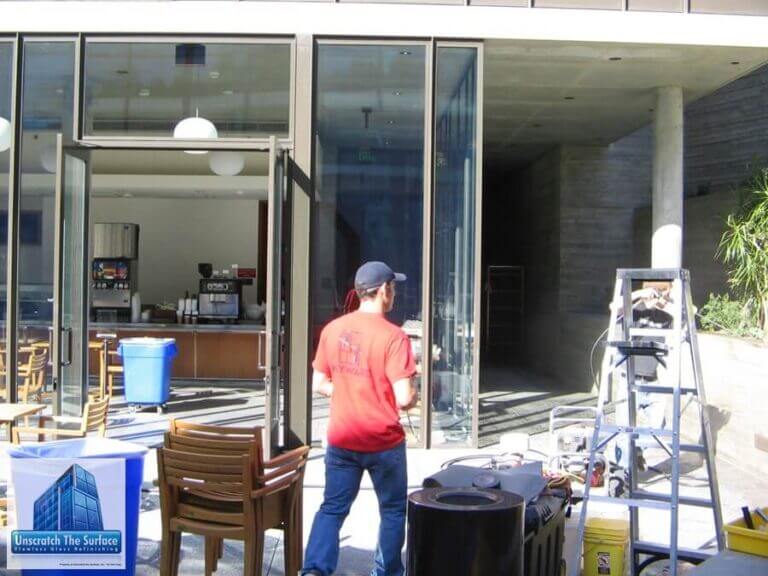
The crew was small. Rick Evans and Joey — brought in through a brief partnership that wouldn’t survive the job’s aftermath but performed brilliantly during it. Joey was a good worker and a good guy. The kind of person you want next to you when the work is hard and the sun is in your eyes.
And the sun was very much in their eyes.
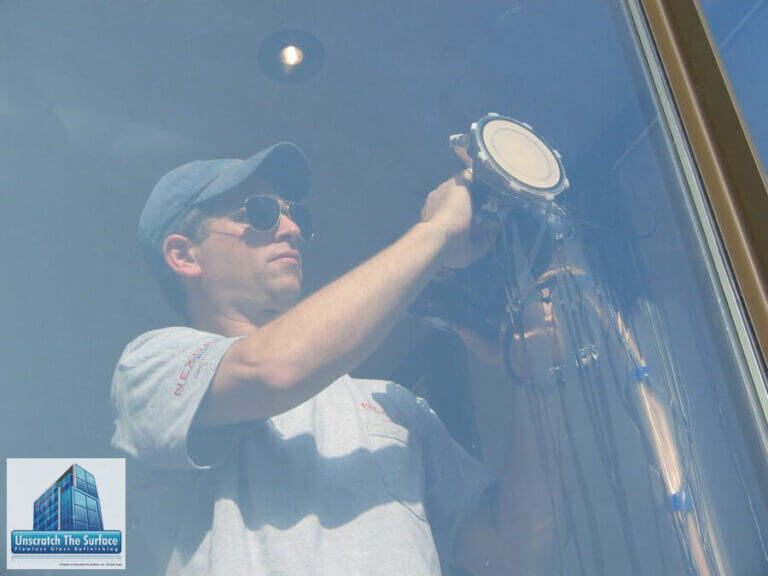
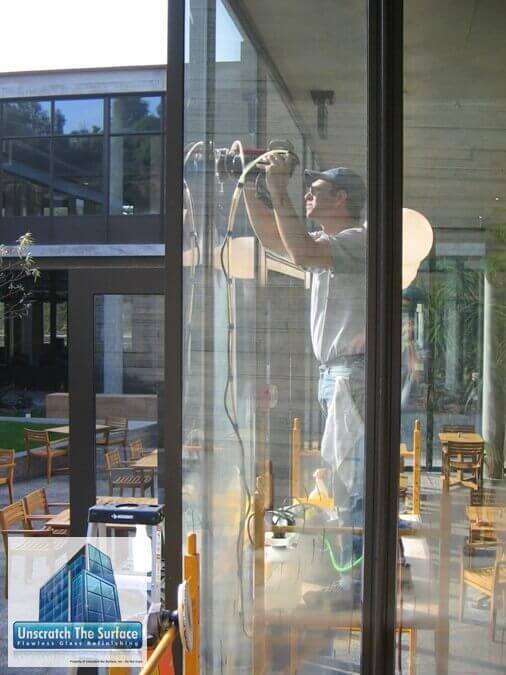
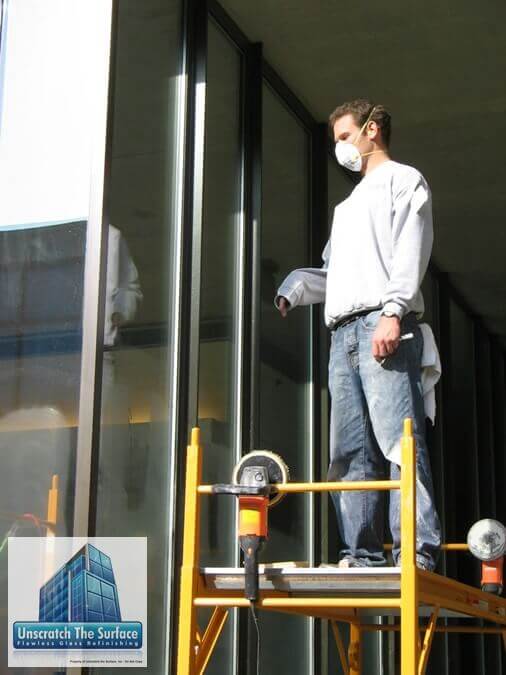
The December Malibu sun sits low in the sky and hits the glass at an angle that turns the entire surface into a mirror. Rick was wearing Raybans the whole two weeks. Didn’t matter — working a glass surface you can barely see while grinding out deep scratches requires feel as much as sight. You learn to read the glass through the machine, through the resistance, through the sound. One photo from that job carries a caption that still makes Rick laugh: “I couldn’t see what I was doing there!” He wasn’t entirely joking.
The equipment in 2005 looked nothing like what Unscratch the Surface uses today. The crew was running SRP Novus machines — the industry standard polisher of the 1990s, a heavy, awkward beast that got the job done if you knew how to push it. For the aggressive sanding phase, they used 80 grit silicon carbide to cut through the deep tempered scratches, pre-polished with 400 grit, then finished clear with the SRP machines. The sanders themselves? $29 Harbor Freight specials. Not a typo.
The heat generated by that much friction on that much glass created another problem — the polishing slurry was overheating constantly. The solution was pure field improvisation: one crew member’s only job for stretches of the day was keeping the slurry buckets cool by nesting them inside 30-gallon garbage cans packed with ice. A $29 sander, a bucket of ice, and a man who figured out how to buff glass scratches that nobody else believed could be removed.
The laminated glass presented its own unique challenge. Unlike standard widespread glass scratch refinishing on a single surface, laminated glass has two layers bonded together — tougher and far less likely to break than annealed glass, which is a genuine advantage when you’re pushing a sander against it for days. But scratches on both sides meant both sides needed to be worked, and any distortion introduced on side one would be compounded by distortion on side two. The finishing standards had to be flawless from the very first pass.
They were. Over 100 linear yards of laminated scratched glass — both sides — restored to optically clear in under two weeks. One hundred thousand dollars worth of glass saved. Deer wandering past in the background. Raybans on. Harbor Freight sanders humming.
The Morley Builders contractor came back at the end, looked at the finished glass, and became a believer.
The Fax That Launched an Empire
Let’s talk about what actually happened in December 2005 — because it’s easy to look at 20 years of memorable scratched glass projects and assume it was always going to be this way. It wasn’t.
Rick Evans was working under someone else’s contractor’s license, selling and installing retrofit windows in San Luis Obispo. During that work he noticed something that the glass industry had largely accepted as an unsolvable problem: construction scratches on tempered glass. Window installers, concrete crews, careless cleaners — they all left their marks on glass that was supposed to be permanent. The standard answer was always replacement. Expensive, wasteful, and according to Rick Evans — completely unnecessary.
He started experimenting. Dry grinding. Different grits. Different machines. Figuring out how to remove scratches from glass through refinishing without introducing distortion, haze, or optical compromise. Nobody was teaching this. There was no YouTube tutorial. No industry forum. Just a guy in San Luis Obispo who was convinced it could be done and kept working until it was.
When he was ready to find work, he picked up the fax machine.
Glass shops. Commercial builders. Property managers. Fax after fax going out to anyone who might one day have scratched glass that needed fixing. Most went straight to the trash. One went to Morley Builders. And Morley Builders had a problem at the Getty Villa that nobody else could solve.
That fax was the beginning of everything.
The Getty Villa job proved three things that would define the next two decades:
First — the process worked at commercial scale. Over 100 linear yards of laminated glass on one of the most prestigious properties in California, restored to flawless in under two weeks. The economics of restoring vs replacing glass were undeniable — $125,000 in glass saved at a fraction of replacement cost.
Second — skeptics become believers when the results are real. The Morley Builders contractor walked away a convert. That pattern — local companies can’t do it, Rick Evans can — would repeat itself from Malibu to Toronto to Notre Dame Stadium to Germany and beyond.
Third — speed matters. The Getty Villa job was completed in under two weeks. That pace — what would eventually become a relentless focus on being the fastest scratched glass restoration operation in the world — was born right here in the hills above PCH with a $29 Harbor Freight sander and a bucket of ice.
The process has evolved dramatically since 2005. The SRP Novus machines are long gone — sold off years ago. The Harbor Freight sanders gave way to professional Makitas and eventually to custom-built equipment that Unscratch the Surface designs and manufactures itself. The techniques refined through hundreds of projects across 27 states and 4 countries. The patent filed and granted. The consulting model invented at the Shangri-La Toronto.
But it all traces back to a fax machine in San Luis Obispo and a phone call from Morley Builders.
As Bruce Springsteen sang — I’m still here. 🎸
What the Getty Villa Means for Your Project
If you are a commercial contractor, property manager, or developer staring at a large volume of scratched glass and wondering whether restoration is actually possible — the Getty Villa answers that question.
In December 2005, before there was a patent, before there was a consulting model, before there were projects in 27 states and 4 countries — there was one guy with a fax machine and a process nobody believed in. He showed up to J. Paul Getty’s former home with Harbor Freight sanders and ice buckets, and he restored over 100 linear yards of laminated tempered glass — both sides — to optically flawless in under two weeks.
If it worked there in 2005 with that equipment, imagine what it looks like now.
Today Unscratch the Surface brings two decades of commercial glass restoration expertise to every project. Custom-built equipment. Proprietary cerium polishing compounds. Techniques refined across hundreds of projects from Santa Barbara custom homes to Denver high rises to large scale commercial projects in Biloxi to the Shangri-La Toronto. The cost of scratched glass repair vs replacement isn’t even close — restoration saves 80-90% in virtually every commercial scenario.
The challenges that make other companies walk away — deep scratches in tempered glass, both sides of laminated panels, curved glass surfaces, glass floors, 95 scratched tempered doors, 66-floor curtainwall systems — are exactly the projects Unscratch the Surface was built for.
Need glass restoration consulting for a large project where training local crews makes more financial sense than flying in a team? That model exists because of what was learned at the Getty Villa and perfected at the Shangri-La Toronto. Need a full service glass restoration team deployed to your site? Same answer. Need to understand how to get a fair price on a complex restoration project? Call us.
We have been doing this since before anyone else believed it was possible. The Getty Villa is proof. Twenty years of projects after it are proof. The patent is proof.
Morley Builders were skeptics. Until they weren’t.
You don’t have to be a skeptic. Read what our clients say — then call us.
Don’t Replace — Unscratch.
📞 805-295-9020 | 888-986-7272
Or fill out the contact form below.