Service Areas — Toronto & Surrounding Region:
- Toronto, ON
- Mississauga, ON
- Brampton, ON
- Markham, ON
- Vaughan, ON
- Richmond Hill, ON
- Oakville, ON
- Burlington, ON
- Hamilton, ON
- Oshawa, ON
- Pickering, ON
- Ajax, ON
- Whitby, ON
- Newmarket, ON
- Barrie, ON
- Kitchener, ON
- Waterloo, ON
- London, ON
- Windsor, ON
- Ottawa, ON
- Montreal, QC
- Vancouver, BC
- Buffalo, NY
- Rochester, NY
- Syracuse, NY
- Albany, NY
- New York City, NY
- Detroit, MI
- Cleveland, OH
- Pittsburgh, PA
- Niagara Falls, NY
Table of Contents

The Building, The Problem, and The Call to California
Every morning for eight months, Rick Evans walked 1.5 miles from his one-bedroom suite near the old Maple Leaf Gardens to a 66-storey glass tower at 180 University Avenue in downtown Toronto.
Large coffee. Bagel. Tim Hortons. Always enough for the crew.
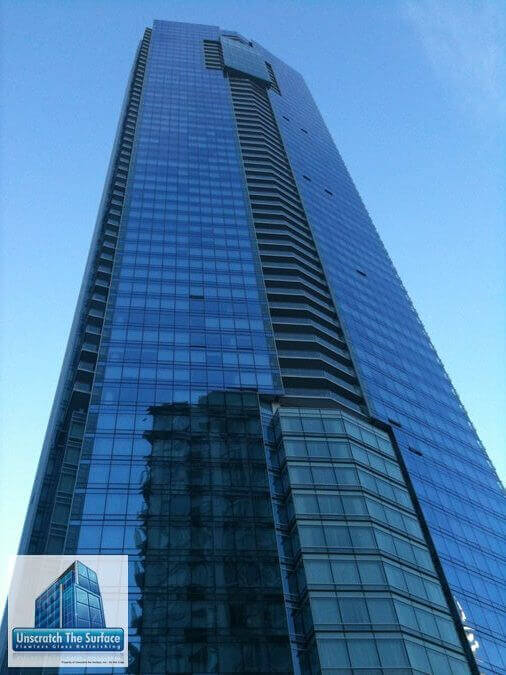
The destination was the Shangri-La Toronto — one of the most prestigious luxury addresses in North America. Floors 1 through 17: the Shangri-La Hotel itself, 202 rooms and suites. Floors 18 through 49: The Residences, 287 luxury condominiums. Floors 50 through 66: Private Estate Units — 83 of the most exclusive residences in Canada, including four two-level penthouses. Entry level in this building was $800,000 Canadian for an 800 square foot one-bedroom. The building also held the fastest elevator in North America at the time — an express ride to the upper floors that felt less like an elevator and more like a controlled free fall.
Peter Mansbridge — the voice of CBC News for three decades, Canada’s most trusted broadcaster — lived here. On the hotel floors, you might catch a glimpse of Kiefer Sutherland grabbing lunch at Rabba’s across the street. During lunch breaks taken in the unfinished upper estate units on floors 50 through 66 — empty shells at the time that would eventually sell for many millions — Rick once had a long conversation with a fellow hockey fan who happened to live in the building. Peter Mansbridge. They talked mostly about the 2014 Sochi Olympics and TJ Oshie’s legendary four-shot shootout performance for Team USA.
This was not a small job. This was not a residential call. This was the project that changed the industry.
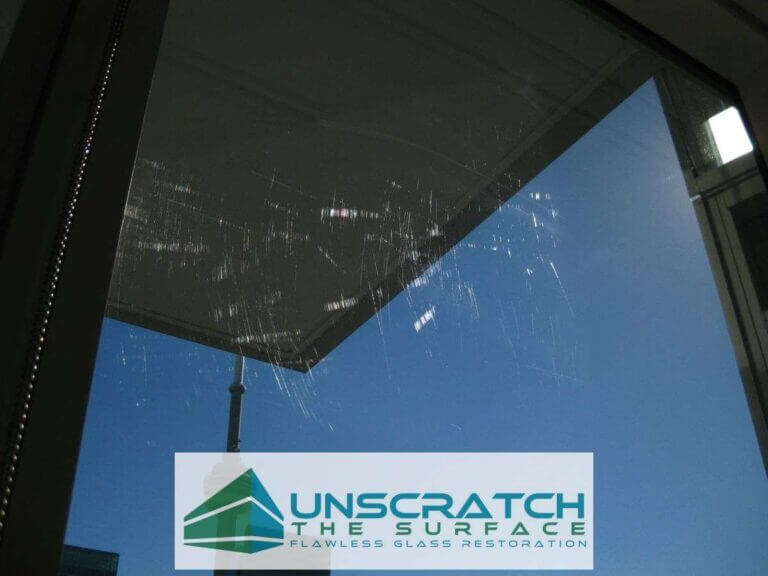
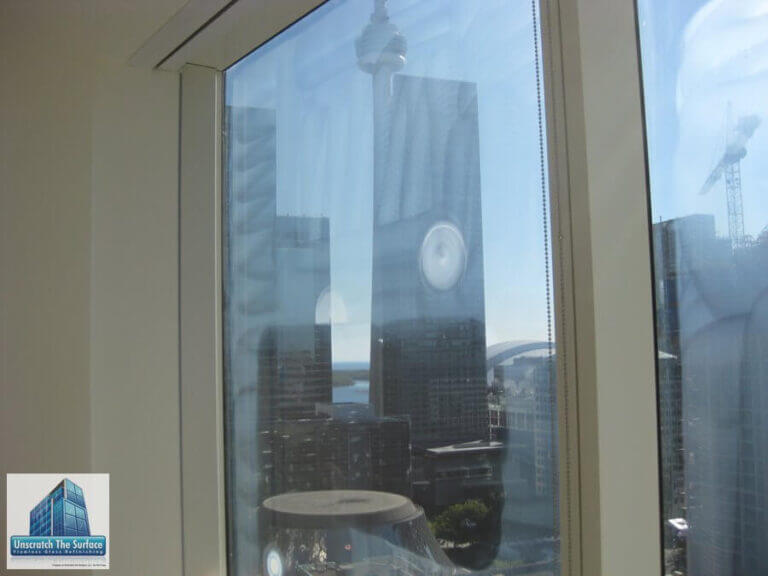
The Shangri-La Toronto’s glass curtainwall had sustained widespread scratch damage throughout the entire building — a combination of fabrication debris fused to the tempered glass surface during construction, compounded by years of careless window cleaning that ground that debris deeper into the glass with every pass. The damage was deep. The scale was enormous. Understanding how deep scratches are removed from tempered glass at this volume requires a level of expertise that simply didn’t exist locally in Toronto at the time.
Local companies were brought in to perform sample demonstrations on the widespread scratched glass. Their results weren’t terrible. But noticeable distortion, swirl marks, and haze on a building of this caliber isn’t acceptable. The search results for “glass restoration near me” had failed them. So they called California.
The Team, The Training, and The Incentive System That Ran the Job
This project didn’t just restore 50,000 square feet of glass. It invented an entirely new service category: glass restoration consulting.
The concept was straightforward but radical. Instead of flying in a full American crew — absorbing international travel costs, eight months of hotel stays, meals, and U.S. workers’ compensation insurance — Rick Evans would arrive, train the developer’s own on-site employees, and supervise the project to a flawless commercial standard. The developer saved a fortune. The money stayed in the Canadian economy. The results exceeded what any local company had delivered.
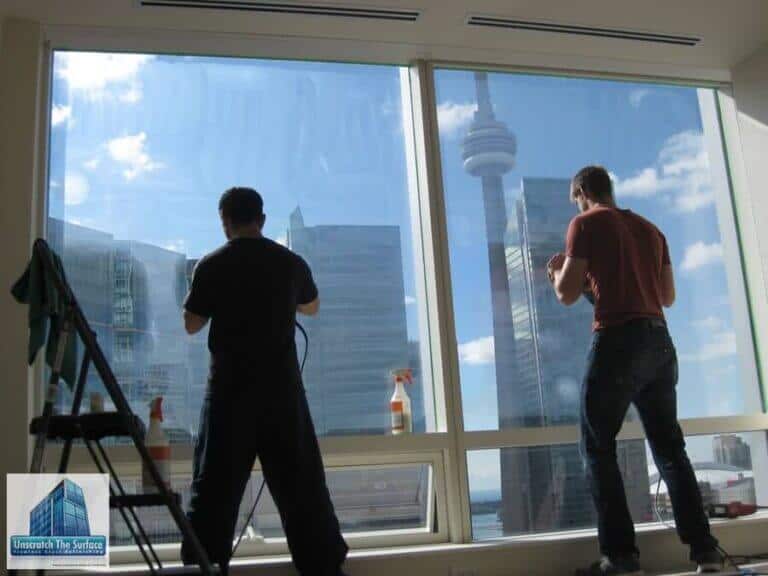
To establish the technical foundation, Rick brought in Scott Webster — a fellow glass restoration professional with over a decade of industry experience and founder of Glass Fix USA. The two had previously collaborated on major projects including the Trinity College restoration in San Antonio, TX. Scott flew into Buffalo, NY, where Rick picked him up and drove him across the border. He worked alongside the crew for a full week, helping establish the technical foundation that would carry the project for the next seven months.
Scott later wrote: “Rick Evans at Unscratch the Surface is among the best in the business… a true perfectionist when it comes to glass restoration, leaving no imperfection untreated. Glass Fix USA has worked with many restoration specialists over the years, but Rick Evans consistently stands out above the rest.”
That is not a customer review. That is a peer endorsement from a fellow industry professional who has seen the best in the business up close and knows exactly what flawless looks like.
Westbank Projects Corp — the developer behind the Shangri-La Toronto — assigned two of their own employees to the project:
Rob — a forklift operator.
Adam — an elevator operator.
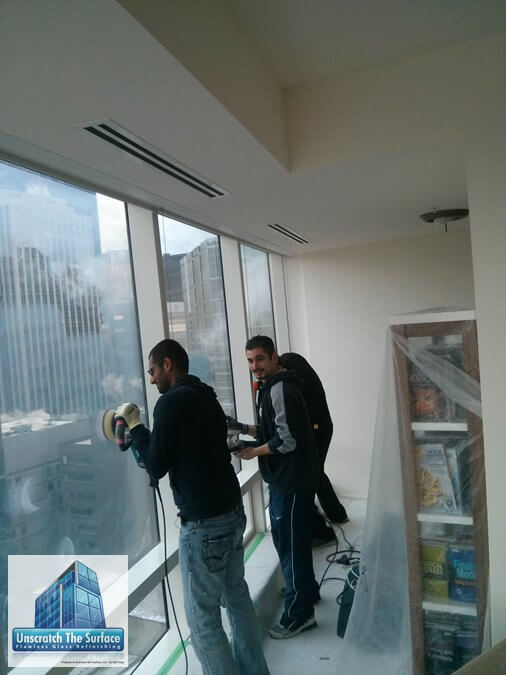
Neither had ever touched a piece of glass scratch removal equipment in their lives. Within two weeks, both were performing flawless commercial-grade tempered glass resurfacing.
Rick established a weekly square footage quota of 750 sq ft as the baseline. But quotas alone don’t inspire people. Incentives do. The bonus structure was simple:
- Hit 850 sq ft in a week → $100 cash each, Friday afternoon
- Hit 950 sq ft in a week → $200 cash each, Friday afternoon
The result was immediate and remarkable. Rob and Adam didn’t just meet the targets — they owned them. They arrived each morning having already calculated which units to tackle first to maximize their weekly square footage. They knew the numbers before the first machine turned on.
“If we do that unit first, we won’t break 850. But if we do the larger unit first, we will.”
They were completely invested. And they never once failed to hit 850.
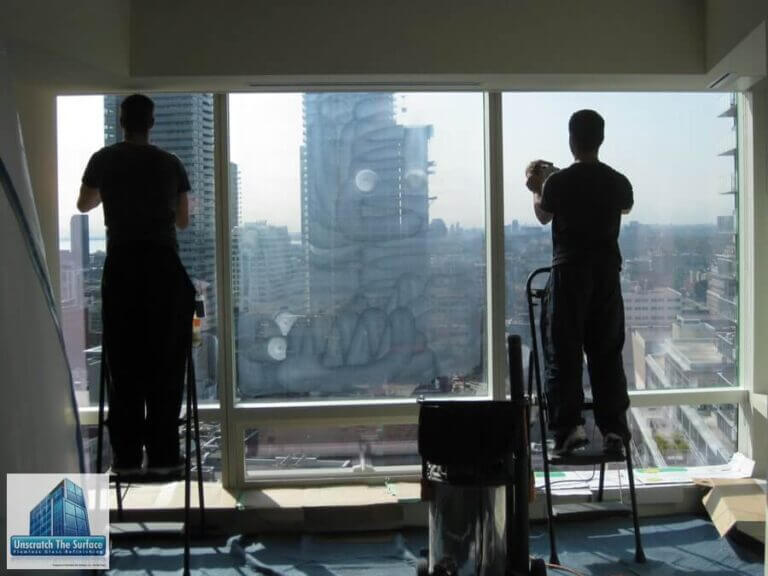
Rick’s role evolved from trainer to logistics manager — fixing broken machines, fabricating custom discs and cerium polishing pads, keeping spray bottles filled, and walking each completed unit before Tej arrived to inspect and sign off. Unlike other companies that only use what tools they can buy, Unscratch the Surface has always made its own equipment — custom discs, polishing pads, and backing pads — which allows adaptation to both the severity of the damage and the individual user. This is what delivers a consistent, flawless finish across 50,000 square feet. As the project progressed, a third crew member was added for the final two months. The consulting model for large resurfacing projects was proving itself in real time.
Eight Months in Toronto — The Human Story
Then there was Tej. Westbank’s construction expert who had transitioned from the building phase into the Shangri-La’s operations team, becoming the hotel’s go-to authority on everything structural and technical. Assigned to ensure Rick had everything he needed to keep the project moving, Tej became a genuine friend.
Most Friday evenings after wrap, the two found a table at Shoeless Joe’s — appetizers, cold drinks, and whatever was on the ice. Rick rooting for his New York Rangers. Tej loyal to his Toronto Maple Leafs. Once, improbably, both teams played each other while Rick was in town. The cheap seats at the Air Canada Centre that night were $400. They watched from Shoeless Joe’s instead. Better table anyway.
By November, temperatures had dropped well below freezing. But the exterior glass on the balconies still needed to be restored. Work didn’t stop. The solution: zip walls erected on each balcony, creating a sealed tent around the work area. Heat from the interior unit bled through the balcony doors, warming the workspace just enough to keep equipment functioning and fingers intact at 10 degrees Fahrenheit. They worked through every floor. Every unit. In the kind of cold that makes a Tim Hortons large coffee at 7am feel like a religious experience.
Chicken shawarma from Rabba’s a few nights a week. The 1.5 mile walk to and from the hotel each morning and evening — until the temperature made that impossible. Toronto in August genuinely feels like California. It doesn’t stay that way.
As for Kiefer Sutherland — spotted exactly once, walking past Rabba’s across the street from the hotel while Rick was taking a call out front (no service on the 50th floor). Rick had his work shirt on — the one that said Los Angeles, CA — hoping Jack Bauer might notice and strike up a conversation. He didn’t. They did not become friends. His loss.
The project completed in March 2014. Toronto sent Rick off with a proper going-away gift: a full blizzard. Rather than paying international freight rates to ship equipment from Canada, Rick loaded everything into a car, drove south to visit his mother in North Carolina, and shipped all equipment domestically from there — saving thousands in international freight charges. Resourceful to the last mile.
What This Means for Commercial Builders and Developers
Here is why every commercial general contractor, luxury developer, and property manager should understand what happened at the Shangri-La Toronto.
The numbers: 50,000 sq ft of deeply scratched tempered glass restored. $7,000,000+ CAD saved over full replacement. Eight months. Two locally trained workers who had never touched restoration equipment. Zero distortion. Zero haze. Zero compromises.
The traditional approach to a project of this scale would require flying in experienced technicians from the U.S., covering months of international travel, hotels, meals, per diem, and U.S. workers’ compensation rates for overseas work. The cost burden alone is substantial before a single square foot of glass is touched.
The Unscratch consulting model changes that equation entirely. One expert arrives. Your existing employees — already on your payroll — are trained to perform commercial-grade glass restoration to a flawless standard. The money stays in your local economy. The results exceed what local restoration companies can achieve. We know this because the local Toronto companies already tried and failed the demo before we arrived.
This is not a theoretical model. It worked at the Shangri-La Toronto — 66 floors, 50,000 sq ft, a forklift operator and an elevator operator delivering flawless results by week three. It worked again at Notre Dame Football Stadium, where the same consulting formula was deployed on the curtainwall restoration with identical results. The system is proven, documented, and repeatable.
If you are a contractor, developer, or insurance adjuster staring at a large volume of scratched glass and wondering about the cost of scratched glass repair vs replacement — relax. Regardless of where your building is located, we can help. We have worked in 27 states, 4 countries, and yes, we survived a Canadian winter on balconies in 10 degree weather to get the job done.
Don’t Replace — Unscratch.
📞 805-295-9020 | 888-986-7272
Or fill out the contact form below.
Frequently Asked Questions — Shangri-La Toronto Glass Scratch Removal
How much did the Shangri-La Toronto glass restoration save over full replacement?
The project saved over $7,000,000 CAD compared to full glass replacement. Restoring 50,000 square feet of scratched tempered glass across 66 floors at a fraction of replacement cost is exactly why glass restoration vs replacement is almost always the smarter financial decision for commercial developers and property managers.
How long did the Shangri-La Toronto glass restoration project take?
The project ran 8 months — from August 2013 through March 2014. The scale was 50,000 square feet of deeply scratched tempered glass across all 66 floors of the building, restored to a flawless commercial standard with zero distortion and zero haze.
What is glass restoration consulting and where did it originate?
Glass restoration consulting is the practice of sending one expert to train a developer’s own on-site employees to perform commercial-grade glass resurfacing — eliminating the cost of flying in a full crew from the U.S. for months at a time. It was invented on this exact project at the Shangri-La Toronto. The same model was later successfully deployed at Notre Dame Football Stadium and other major projects. Learn more about glass restoration consulting services.
Can you train our existing employees to perform commercial glass restoration?
Yes — and the Shangri-La Toronto is the proof. Two Westbank Projects Corp employees — a forklift operator and an elevator operator — were trained to perform flawless commercial-grade tempered glass scratch removal within two weeks. They went on to restore 50,000 square feet to a standard that exceeded what local glass restoration companies could deliver. Your employees, your payroll, our expertise.
What caused the scratches at the Shangri-La Toronto?
The damage was caused by a combination of fabrication debris fused to the tempered glass surface during construction, compounded by years of careless window cleaning that ground the debris deeper into the glass with every pass. This is one of the most common causes of widespread scratching on large commercial curtainwall buildings.
Do you travel internationally for large commercial glass restoration projects?
Yes — the Shangri-La Toronto is proof of that commitment. Unscratch the Surface has completed projects in 27 states and 4 countries including the United States, Canada, Germany, and Mexico. No project is too remote or too large. If the glass needs restoring, we find a way to get it done. Local isn’t always the best option — especially when the standard has to be flawless.
Why did the Shangri-La Toronto choose Unscratch the Surface over local companies?
Local Toronto glass restoration companies performed sample demonstrations and were not awarded the project. Their results showed noticeable distortion, swirl marks, and haze — unacceptable on a building of this caliber. Unscratch the Surface delivered a flawless finish with zero distortion using proprietary custom-made equipment that no other company in the world replicates. The results — and the $7M+ in savings — spoke for themselves.